Quick answer: The split sleeper berth rule lets property-carrying CDL drivers meet their 10-hour off-duty requirement in two pieces instead of one. One period must be at least 7 consecutive hours in the sleeper berth. The other must be at least 2 consecutive hours, off duty or in the berth. Together they must add up to at least 10 hours, so the legal splits are 7/3 and 8/2 (or anything longer, like 7.5/2.5). When you pair them correctly, neither period counts against your 14-hour window.
The split sleeper berth is one of the most useful tools in the hours-of-service rules, and one of the most misunderstood. Used right, it lets you wait out a traffic jam, a slow dock or a bad weather window without burning your 14-hour clock. Used wrong, it's a violation on your log. Here's how it actually works, with a worked example.
The basic hours-of-service rules it works with
For property-carrying drivers, the core limits are:
- 11-hour driving limit: up to 11 hours of driving after 10 consecutive hours off duty.
- 14-hour window: you can't drive past the 14th hour after coming on duty.
- 30-minute break: required after 8 cumulative hours of driving. Off-duty, sleeper berth or on-duty not-driving time can all satisfy it.
- 10 hours off: needed to reset your 11 and 14.
The split sleeper berth provision is a different way to get those 10 hours off.
How the split sleeper berth rule works
Under the current rule (in effect since September 2020), you can split your 10 hours into two qualifying periods:
- The long period: at least 7 consecutive hours, and it must be spent in the sleeper berth.
- The short period: at least 2 consecutive hours, either off duty, in the sleeper berth, or a combination.
- Together: at least 10 hours.
- Order doesn't matter: you can take the short period first or the long one first.
That gives you a 7/3 split, an 8/2 split, or anything in between. A 6/4 or 5/5 split does not qualify under the standard rule.
Why it saves your 14-hour clock
Once both periods are complete, neither one counts against your 14-hour window. Your available hours are then recalculated from the end of the first qualifying period. That's the part most drivers find confusing, so here's an example.
A 7/3 split, step by step
- 6:00 a.m. Come on duty and start driving.
- 2:00 p.m. After 8 hours of driving, stop for a 3-hour off-duty break (2:00 to 5:00 p.m.). This also covers your 30-minute break.
- 5:00 p.m. Drive 3 more hours, to 8:00 p.m. That's 11 hours of driving for the day.
- 8:00 p.m. Go into the sleeper berth for 7 hours, until 3:00 a.m. Three hours plus seven hours makes 10, so the pair qualifies.
- 3:00 a.m. Now count from the end of the first period (5:00 p.m.). Since then you've used 3 hours of driving and 3 hours of your window, not counting the 7 hours in the berth. That leaves you 8 hours of driving and 11 hours of window available.
From there, your next qualifying break pairs with the 7-hour berth period and the count moves forward again. Most ELDs calculate this automatically, but it pays to understand the logic so you can plan your day and spot an error.
Common split sleeper mistakes
- Logging the long period as off duty. The 7-plus-hour period has to be in the sleeper berth, not just off duty.
- Cutting a period short. 6 hours 50 minutes in the berth is not 7 hours. The periods must be consecutive and meet the minimum.
- Counting from the wrong point. After the pair is complete, hours are recalculated from the end of the first qualifying period, not from when you first came on duty.
- Assuming 6/4 or 5/5 is legal. Not under the standard rule (more on that below).
- Applying it to passenger carriers. Bus and motorcoach drivers have a different sleeper berth rule.
What about 6/4 and 5/5 splits?
FMCSA has proposed a Flexible Sleeper Berth pilot program that would test 6/4 and 5/5 splits, along with a Split Duty Period pilot that would let drivers pause the 14-hour clock for up to three hours. These are pilot programs for a limited group of enrolled drivers, not a rule change. Unless you're officially enrolled, 7/3 and 8/2 are still the only qualifying splits. Check the FMCSA hours-of-service page for the latest status.
The split only works if you actually sleep
The rule assumes those 7 or 8 hours in the berth are real rest. Running a split means sleeping at odd hours, often in daylight, with trucks idling next to you. That's hard on any body, and a thin stock mattress makes it worse.
A few things make split sleep count:
- Block the light. Blackout curtains or a sleep mask matter more on a split than on a normal night.
- Kill the noise. Earplugs or a white noise app help you fall asleep faster when you only have 7 hours.
- Keep the cab cool. Most people sleep better in a cool room.
- Sleep on real support. A mattress that lets your hips sink keeps waking you up to reposition.
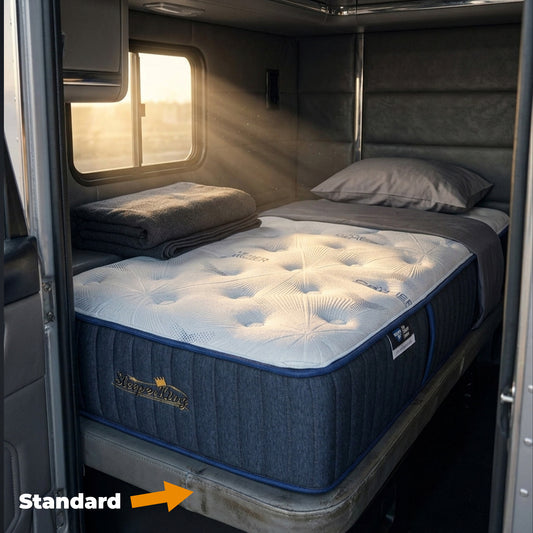
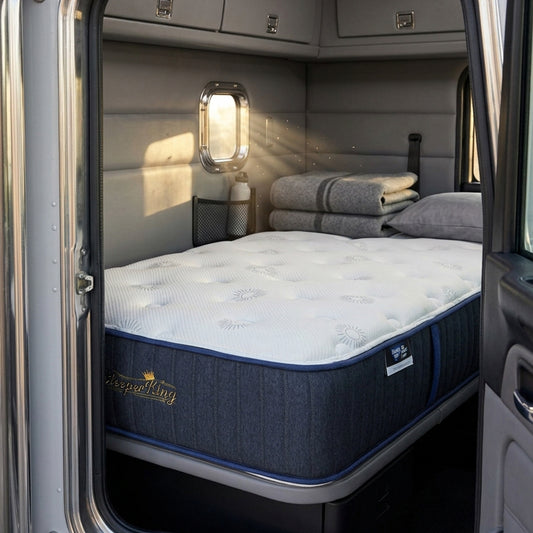
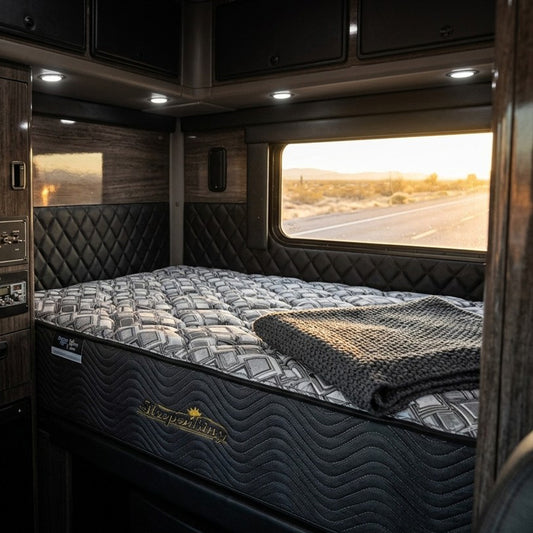
That's where a proper bunk mattress pays off. SleeperKing's semi truck mattresses are 12-inch hybrids with up to 1,000 individually encased coils, made in the USA in 36×80, 39×80 and 42×80. The Serenity adds a copper-infused lumbar layer, and the double-sided Premium has a cool gel side for daytime sleep in summer. See how they compare in our best semi truck mattress guide, and get more rest tips in sleeping in a semi truck.
Finding a spot is half the battle, so plan your split around parking too. See our truck parking and sleep tips.
This article explains the federal rule in general terms and isn't legal advice. Your carrier's policies and your ELD settings apply too. When in doubt, check with your safety department or FMCSA.
Frequently asked questions
What is the split sleeper berth rule?
It lets property-carrying drivers split the required 10 hours off duty into two periods: at least 7 consecutive hours in the sleeper berth and at least 2 consecutive hours off duty or in the berth, totaling at least 10 hours.
Is a 7/3 split legal?
Yes. A 7-hour sleeper berth period paired with a 3-hour off-duty or sleeper berth period qualifies, and so does 8/2.
Does the split sleeper berth stop the 14-hour clock?
When both qualifying periods are completed, neither one counts against the 14-hour window. Available hours are recalculated from the end of the first qualifying period.
Can I do a 6/4 or 5/5 split?
Not under the standard rule. FMCSA's Flexible Sleeper Berth pilot program tests 6/4 and 5/5 splits, but only for drivers officially enrolled in it.
Does the 2-hour break count as my 30-minute break?
Yes. Any 30 consecutive minutes off duty, in the sleeper berth or on duty not driving satisfies the 30-minute break requirement.